Luang Phor Pan (Phra Khru Phiphat Nirotkit)
Wat Pan Prasit Aram (Wat Pikka), Khlong Dan Sub-district, Bang Bo District, Samut Prakan
Contents
Born
B.E. 2368 (1825), Bang Hia Sub-district, Bang Bo District, Samut Prakan
Ordained at
Wat Arun Ratchawararam (Wat Chaeng), Thonburi
Preceptor
Chao Khun Si Sakyamuni
Siblings
5
Family Background
Luang Phor Pan was born during the reign of King Nangklao (King Rama III). His father was named Nu Chin and his mother was named Tan. He had four siblings by the same parents, making five children in all:
- First child: Mr. Thep
- Second child: Mr. Tat
- Third child: Mr. Pan (Luang Phor Pan)
- Fourth child: Mr. Chan
- Fifth child: Ms. Chaem
During the reign of King Vajiravudh (King Rama VI, Phra Mongkut Klao), the Surname Act was enacted. Luang Phor Pan's descendants took the name of their forebear and adopted the family name "Nu Thep".
Ordination and Education
His parents took Luang Phor Pan to be placed in the care of Chao Khun Si Sakkasunthon, abbot of Wat Arun Ratchawararam (Wat Chaeng) in Thonburi. He was later ordained as a novice at Wat Chaeng while still a child, in order to study the Dhamma and the monastic discipline (Vinaya).
When he came of age, he was ordained as a monk (bhikkhu) at Wat Chaeng, with Chao Khun Si Sakyamuni as his preceptor (upajjhaya).
After his ordination, Luang Phor Pan stayed on for many years to study the Dhamma and the Vinaya under his preceptor, and he developed a deep interest in kammatthana (meditation). Kammatthana is a special teaching of Buddhism: it cleanses the mind and uproots one's own wrong views, the latent tendencies of a mind steeped in the cycle of rebirth (vatta), so that they fade away and only the Dhamma, the teaching of the Lord Buddha, remains in the heart.
History of His Hometown
Luang Phor Pan's ancestors migrated from Ayutthaya when the city fell to the Burmese for the second time (B.E. 2310 / 1767). They settled in the area of Ban Sanam Ruean, also known as Ban Khok Setthi ("Wealthy Mound Village"), because all of those who migrated at that time were wealthy people.
The area was then still dense wilderness. A river flowed through the thick forest out to the sea at Bang Hia. Each time the tide rose, salt water surged up the rivers and canals, causing the villagers who had built their homes there constant hardship.
In this zone where sea water and fresh water meet, land and aquatic animals were abundant. Especially numerous were monitor lizards ("tua hia"), which fed on crabs and fish. The villagers later built a sluice gate to hold back the sea water, so that salt water would not mix with fresh water, and also to stop the many reptiles from spreading along the canals. For this reason the villagers named the village "Ban Bang Hia" and the river "Bang Hia River".
Local Temples
There are two temples at Bang Hia: Wat Bang Hia Nok (Wat Mongkhon Khothawat) and Wat Bang Hia Nai (Wat Khotharam). Both stand on the banks of the Bang Hia River, because the villagers built their homes along the water on both banks, with distances between the settlements.
Returning to His Hometown
Having studied kammatthana to his satisfaction, Luang Phor Pan paid respects and took leave of Somdet Phra Si Sakyamuni, who was both his teacher and the abbot of Wat Chaeng, and traveled home to Wat Bang Hia Nok, his birthplace. A monk named Luang Phor Ruean accompanied him and stayed with him; the two always liked to travel together.
At Wat Bang Hia Nok, Luang Phor Pan was appointed to oversee the monks of the temple. The abbot at that time, Luang Phor Than, appointed him to supervise the monks and novices in their practice and studies, with Phra Achan Im as his assistant.
Luang Phor Pan governed the resident monks and novices strictly. In particular, he trained the monks, novices, and lay Buddhists in the practice of kammatthana meditation, teaching them to sit in meditation and cultivate the mind every day without fail. He himself practiced so strictly that the monks and novices held him in great reverence and awe.
King Chulalongkorn (Rama V) Bestows Royal Favor
Around the beginning of B.E. 2452 (1909), the sluice gate that held back the Bang Hia River, known today as the "Chonlahan Phichit Sluice Gate" or, more commonly, the Khlong Dan Sluice Gate, could no longer hold the water. However skilled the engineers who repaired it, the gate failed again every year. Eventually, local officials consulted one another and petitioned King Chulalongkorn (Rama V), asking that His Majesty graciously agree to visit in accordance with his subjects' wishes.
At that time King Chulalongkorn (Rama V) was a monarch of great power and prestige. Wherever he traveled, that place would prosper, and his presence was a great blessing to his subjects and to the place itself. When the King learned of the petition from the officials, high and low, he graciously agreed to make the journey as his subjects wished.
The Chonlahan Phichit Sluice Gate can be regarded as one of the most important sluice gates of its time, because King Rama V traveled there by royal barge and stayed for three days. What the people of Bang Hia remember with the deepest gratitude is that His Majesty changed the name of Bang Hia Sub-district to Khlong Dan Sub-district, the Bang Hia River to the Khlong Dan River, and the Bang Hia District to Bang Bo District. It was an auspicious sign that the people of Bang Hia became the people of Khlong Dan, as they remain to this day. It was also a great fortune that the King bestowed these names himself, without his subjects having requested them in any way. Later generations should remember and take pride that Bang Hia Sub-district was once favored by a king of the past, and should always remember his great kindness for all time.
The Magic Stone
Luang Phor Pan of Wat Bang Hia Nok was a monk skilled in sacred knowledge and in the powers of the mind, and he could often manifest extraordinary powers before the eyes of his lay followers. The following stories of his remarkable qualities have been handed down.
Luang Phor Pan was a wandering forest monk (dhutanga). Whenever he had the chance, he liked to go into the forest in search of solitude and to practice the Dhamma alone. Generally, however, he was regularly accompanied by monks and novices who practiced with him.
It was on one of his dhutanga kammatthana journeys that Luang Phor Pan came upon what is called the "magic stone".
The magic stone was a very bright green object about the size of a black bean. Beside it lay a stone turtle carved from sandstone, of a slightly reddish-brown color. Luang Phor Pan knew through his mind-reading powers and through visions that he would obtain this object even before setting out on the journey. Afterwards he brought it back to Wat Bang Hia Nok (Wat Mongkhon Khothawat), Khlong Dan Sub-district, Bang Bo District, Samut Prakan.
The Secret in the Shrine
Phra Khru Kosol (Pasathiko) related that Luang Phor Pan never revealed anything about this wondrous object to anyone. He placed it in a shrine built within the temple grounds. In the old days, ancient temples often had a small spirit shrine (san phiang ta) in which the abbot enshrined a Buddha image, and this was a sacred stone Buddha image. Some of these shrines at certain temples were also the dwelling places of deities who guard the monastery, for the sake of peace and happiness. Luang Phor Pan placed the magical turtle, carved from sandstone, in the shrine. People who passed by or came to pay respects to the Buddha image in the shrine would often see that the stone turtle was sometimes missing, but no one paid much attention, content simply to have paid respects to Luang Phor Pan at the shrine. The stone turtle seemed only an ordinary object. What was worth noticing is that each time the turtle disappeared, it was at the same time that Luang Phor Pan was away, and everyone assumed he had gone on a dhutanga journey in the forest. But if so, why would he take the stone turtle with him? It was heavy and hard to look after. Two days later Luang Phor Pan would return to the temple, and the stone turtle would be back in its old place. This puzzled one young novice, who began to watch what became of the stone turtle, wondering where it went and who carried it off, heavy as it was.
The Flying Stone Turtle
This young novice was extremely determined. He hid himself and secretly observed the stone turtle, which had two bright, clear green stones for eyes. Luang Phor Pan had gathered the pieces together, and when the green stones were fitted into the eye sockets of the stone turtle they fitted perfectly, so he assembled them completely and placed the turtle in the shrine.
But the novice's determination did not escape the wisdom of his teacher. Luang Phor Pan knew that the novice had become curious about the stone turtle disappearing at the same time as himself, so he quietly came to watch how clever the young novice would be.
The novice witnessed the marvel on the night of the new moon, in the waning half of the lunar month. As soon as it grew dark, Bang Hia fell into deep darkness. Only the faint glimmer of kerosene lamps could be seen here and there, and most people had put out their lights and gone to sleep. Suddenly the young novice froze, stunned and numb, for before his eyes the stone turtle was moving, crawling out of its place. Then the stone turtle rose into the air, and it would not be wrong to call it a flying stone turtle, and vanished. The novice forced himself to stay awake, enduring in order to see whether the turtle would return to its place. Almost at dawn, at about 4 a.m., the novice was amazed once more: the stone turtle with its clear green eyes flew back and crawled into its old place as if nothing had happened. The novice went over and turned the turtle over to examine it, and found nothing unusual: it was just an ordinary carving in sandstone. If it were not a sacred object, it surely could not crawl and fly through the air.
Where Is This Island?
Luang Phor Pan of Wat Bang Hia Nok secretly watched his young novice disciple for several days. He wanted to test the novice's perseverance and quick wits, to see how he would resolve his doubts and cope. The young novice had no idea that his teacher was watching him, because he was absorbed in watching the stone turtle. Eight o'clock in the evening in Bang Hia in those days was already quite late. The novice kept watch as the stone turtle vanished by rising up and flying away, and it would return to its place at 4 a.m. every 15th day of the waning moon. At last, this time, the young novice waited in readiness, prepared to go on an adventure with the stone turtle no matter what.
When the time came, the stone turtle with its bright green eyes slowly crawled down from its place and went straight to the open ground before rising into the air. The young novice dashed out from his hiding place, leapt up, and hugged the large stone turtle tightly. The turtle slowly rose and then flew through the sky. The novice held on tightly for fear of falling. At last they arrived at an island. The novice did not know what place it was or what corner of the world it lay in. Looking around, he saw a cool, pleasant, and utterly delightful radiance.
It Was Real, Not a Dream
The stone turtle slowly descended. Once on the ground, it went straight to a bamboo grove to feed on bamboo shoots, shoot after shoot, eating without ever seeming to be full. The novice saw a bamboo shoot close by and tried to break one off with his left hand, as a keepsake and as his own witness to dispel the doubt of whether he had only dreamed of being on this island, and to prove that he had truly come there with the stone turtle. The stone turtle ate its way along through the bamboo shoots, and the novice did not dare get down from its back for fear of being left behind. At last his left hand managed to wrench off one shoot, which he clutched tightly. The stone turtle ate who knows how many dozens of shoots until it was time, and then flew back at once. But on the way back the young novice could not remember the route at all. When they arrived back at the original spot, the young novice carried the bamboo shoot back to his hut, and the stone turtle returned to its place.
Removing the Magic Eyes
Luang Phor Pan had considered everything thoroughly. The secret of how he had obtained the stone turtle and its green stone eyes was a secret no longer. So Luang Phor Pan came out of hiding, went straight to the stone turtle, pried out the bright green magic eyes, and put them away. From that day onward,
the sandstone turtle that Luang Phor Pan had found in the forest during his dhutanga journey could no longer fly through the air. Today this stone turtle is still said to be at a temple in a neighboring province. As for the magic eyes, it is believed that Luang Phor Pan presented them to King Chulalongkorn (Rama V), since such a wondrous object could not be kept by an ordinary person, only by one with great merit and authority, a ruler of the land. Phra Khru Kosol (Pasathiko) described the bright green stone as slightly elongated, about the size of a black bean, and beautiful and sparkling like a diamond of the finest water.
Testing Skill, Meeting Skill
Once, Luang Phor Pan went on a dhutanga journey toward Prachin Buri Province and arrived at Wat Pho Si. When he arrived, the abbot of that temple was stretching the skin onto the midday drum. Seeing this, Luang Phor Pan immediately lent a hand. When it was finished, the abbot invited Luang Phor Pan up to his hut. While they talked, the abbot was rolling a small round ball of clay in his hand. After a while, the abbot tossed the clay ball into the air, and it turned into a horse and a doll chasing a hawk across the sky.
Luang Phor Pan laughed with delight at the sight but said nothing. But after he had come down from the abbot's hut, he said to the monks of that temple, "I've met my match." When he finished speaking, he took the sanghati robe draped over his shoulder, and it turned into several rabbits running around the temple courtyard. No one who tried to chase them could catch them, to the great amazement of all who saw it. For this reason, whenever Luang Phor Pan went on a dhutanga journey, he always headed toward Si Maha Phot District in Prachin Buri Province, because that area was full of teachers with formidable sacred knowledge, and at times he could learn further knowledge he had not yet mastered and raise his own skills higher still.
This Life Is So Short
There are many accounts of Luang Phor Pan's remarkable qualities. Phra Khru Kosol (Pasathiko) related the following. Luang Phor Pan was masterful in matters of the mind and displayed many powers; he was a senior elder monk revered by a great many lay followers. He once told of the wondrous turtle that took him to the hidden city of Lap Lae, a realm of existence layered within this one, where he met with many marvels that serve as reminders for reflection.
After returning from that journey, Luang Phor Pan intensified his practice of kammatthana, letting no time go to waste, because he realized that his life was very short. While he had time, he should gather the profit that comes from meditation, making the mind bright and joyful and building the strength of mind, concentration, and wisdom to accompany him into the future. His method of contemplating the Dhamma was to reflect on the true nature of the cycle of rebirth (vatta), so as to withdraw from birth, withdraw from aging, withdraw from sickness, and withdraw from death.
Because the Mind Clings
Luang Phor Pan understood with certainty that everything in this world keeps changing and turning through time because the mind clings to things. All causes arise from a mind that constantly proliferates in its moods and emotions. When that turmoil is stilled, happiness arises. The stilling of all causes is not found anywhere else: it must be done in the mind, because the mind is the root cause. The mind is the chief, the mind is the one that brings stillness. Whatever is gained is gained in the mind, and whatever is lost is lost in the mind alone.
A Supreme Leader
In governing the resident monks and novices, Luang Phor Pan took the Brahmaviharas (the Four Sublime States) as his foundation:
- Metta: loving-kindness, the wish for others to be happy
- Karuna: compassion, the wish to help others be free from suffering
- Mudita: sympathetic joy, delight in the good fortune of others
- Upekkha: equanimity, remaining neither glad nor sorry when others meet misfortune
As for education, any monk or novice who wished to spend the rains retreat (vassa) at his temple first had to memorize the "7 Tamnan" and the "12 Tamnan" chants. Otherwise he would be allowed to stay for only 3 rains retreats, and if he still could not recite them, he was told to reflect on himself and consider his position. The education of monks and novices at that time consisted only of studying the Vinaya, taking the monastic discipline as the main principle, because Luang Phor Pan was very strict in the Dhamma and Vinaya. His one single aim was the practice of kammatthana: training the mind to be clean and pure, with Nibbana as the goal, so as to escape the woeful realms and the endless cycle of rebirth. Luang Phor Pan strongly emphasized that his resident monks and novices follow the path of practice strictly, and every year after the end of the rains retreat he would lead the monks and novices on dhutanga journeys to various places as a regular practice.
Luang Phor Pan's Holy Water
Every time Luang Phor Pan traveled on dhutanga along his usual routes, villagers along the way would come out to ask him for holy water. He had prepared his holy water in advance, poured it into a kettle, and carried it with him, pouring some out for whoever asked. Remarkably, though the water in his kettle was very little, it never ran out, even though he poured it out for villagers all along the way. This amazed the villagers who witnessed it. His holy water was very sacred: whoever received it would meet only with auspiciousness for the whole family, and women who had difficult childbirths who asked him for holy water would give birth more easily than usual. The villagers have preserved the routes he walked as private paths, which can still be seen today in Khlong Dan Sub-district, although some have been covered over by buildings in the long years that have passed.
Luang Phor Pan's Temples
Because of the great spiritual power that Luang Phor Pan cultivated, people's faith in him has never faded. Wherever he set up his umbrella-tent (klot) to practice the Dhamma, after he moved on, the villagers would build a mound of earth as a stupa, as a memorial so that later generations would know that this was a place where Luang Phor Pan had stayed to practice kammatthana. In some places they even built temples, such as Wat Si Chanthararam, Wat Sawang Arom, Wat Pan Prasit Aram, Wat Song Khlong, and Wat Hong Thong.
In truth, Luang Phor Pan did not build any of those temples himself. They were simply places he passed through on dhutanga and where he stayed briefly to practice, pitching his umbrella-tent only temporarily. But out of faith and devotion to his way of practice and his sincere dedication to Buddhism, Buddhist villagers joined together to found temples in remembrance of his constant kindness toward his disciples, until he passed away. His embodiment of the Brahmaviharas has therefore remained immortal to this day. So that later generations may understand correctly: the temple where he spent the rains retreat is Wat Mongkhon Khotharam, Khlong Dan Sub-district, Bang Bo District, Samut Prakan. The people jointly renovated his hut in B.E. 2517 (1974), keeping the original site and form, and it is where his cast image is enshrined today (as of B.E. 2535 / 1992).
Luang Phor Pan's Cast Image
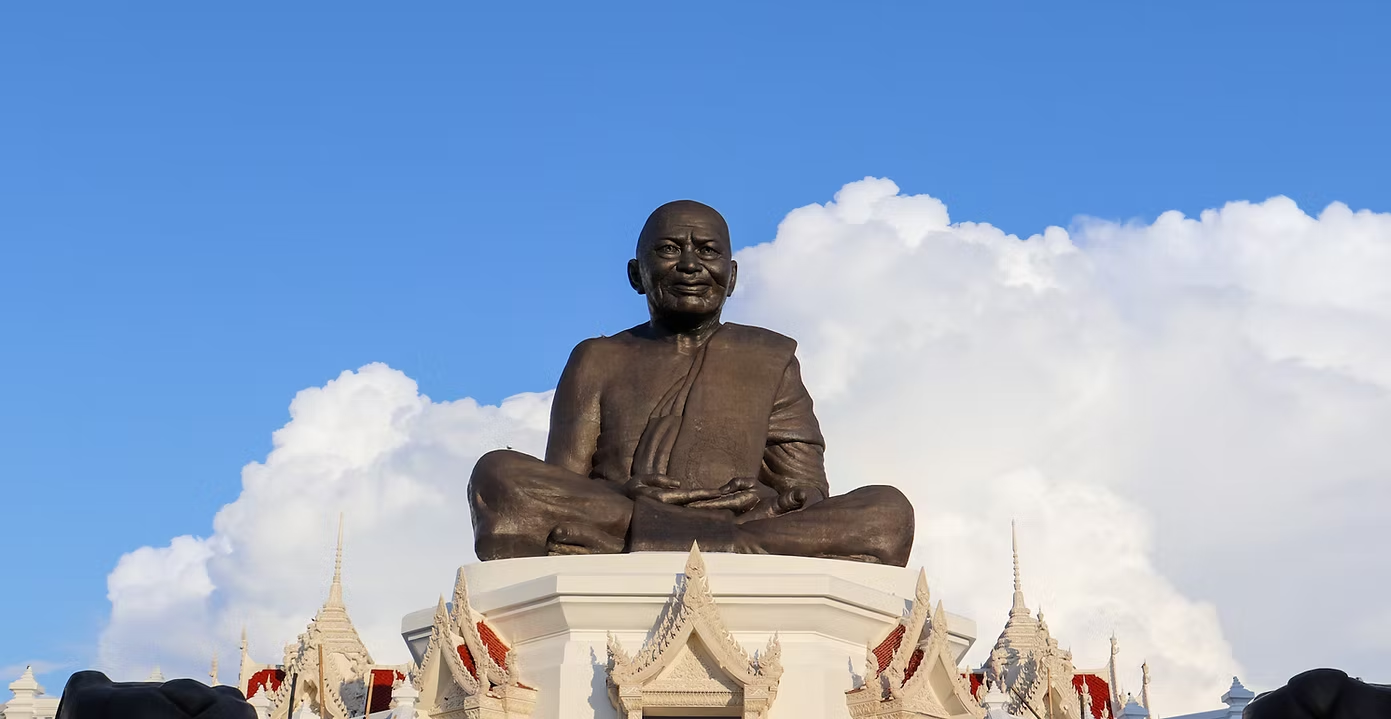
Before Luang Phor Pan passed away, the people who revered him all shared the same idea: together they cast an image of Luang Phor Pan, life-size like his actual body. (He usually went on dhutanga every year and would return to the temple only close to the start of the rains retreat.) Because Luang Phor was rarely resident at the temple, villagers who came to pay respects to him there were regularly disappointed. So the villagers jointly cast a likeness to stand in for Luang Phor Pan, so that when he was away they could pay respects to his cast image instead.
But after the likeness was cast, Luang Phor hardly came into the temple at all. He retreated to stay at Phra Pathom Khlong Dan, another place where he regularly pitched his umbrella-tent to practice, located south of the temple, not far from his own temple. The reason Luang Phor Pan did not wish to stay in his temple was that he apparently knew through his mind-reading powers, in advance, that his life was nearing its end. Although he knew, he did not dare tell anyone, but he gave signs to show that he did not want to stay in the temple, since if he did, he would not live much longer and his body would pass away like the life of every other person. When lay followers pleaded with him, he would deflect by saying, "I can't go in, Ai Dam is there. If I go in, Ai Dam will kill me." The "Ai Dam" of Luang Phor Pan's words was his own cast image. The cast image, being a metal representative of Luang Phor Pan, would not need a body that grows on cooked rice and fish, that rots and decays day by day, that is not lasting, and that would bring sorrow and grief to those left behind. So Luang Phor Pan deflected by saying that Ai Dam was there. Today the cast image of Luang Phor Pan that he called Ai Dam is enshrined at Wat Mongkhon Khothawat, in the newly restored hut of Luang Phor Pan.
Miracles of the Cast Image
The cast image of Luang Phor Pan is just as sacred as the man himself. Devotees from every place come to pay respects to it without fail. The sacredness and power of Luang Phor Pan's image is well known to the people of Khlong Dan Sub-district and nearby, as well as to people from distant places. Some have come to make a wish and take his holy water to drink to be cured of various illnesses, and were healed just as they wished. Others, lying sick, have had Luang Phor appear in their dreams telling them to take his holy water as treatment, and they recovered without needing to see any doctor.
Once, the son of a Khlong Dan villager, Mr. Preecha, fell ill. He took him to Chulalongkorn Hospital because the illness was very severe. After two days at the hospital, the doctors still could not tell what was wrong. In his worry for his son, he prayed to Luang Phor Pan as he lay down at night, and that very night he dreamed that Luang Phor Pan told him to give his holy water to the patient, to take the gold leaf pasted on the image's lips and rub it on the patient's forehead, and to bring the patient home, and he would recover. Mr. Preecha did everything as in the dream. His son, whose illness had been so severe that the doctors could not diagnose it and left him in hospital for two days, began to improve and gradually recovered from the disease. There are many others who have experienced the miracles of the sacred image of Luang Phor Pan at Wat Mongkhon Khothawat. Even senior elder monks of that time, whenever they had business at this temple, would always pay respects to Luang Phor Pan's cast image first. At times the image has even appeared in the dreams of former abbots, telling them to light incense and candles in worship. Its power and sacredness have not faded in the slightest, because it was cast while Luang Phor Pan was still alive, and so it is regarded as the first replica image, enshrined at Wat Mongkhon Khothawat to this day.
The images enshrined at other temples were created out of faith and devotion to Luang Phor, as replicas of the cast image of Luang Phor Pan of Wat Mongkhon Khotharam, made in many places out of the reverence of a great many people. But the true original image is the one enshrined at Wat Mongkhon Khothawat, Khlong Dan Sub-district, Bang Bo District, Samut Prakan, to this day.
Luang Phor Pan in his day was not only a man of miraculous powers and truthful words; he was also full of compassion for those in distress. Once, several soldiers who had deserted from military service came to be ordained at Luang Phor Pan's temple. Out of kindness toward those who sincerely wished to ordain, Luang Phor arranged the ordination as they wished. After the ordination, word reached the army, which reported it to the Sangha authorities. The head of the Sangha administrative circle (monthon), who at that time served in the role of today's provincial Sangha head, summoned Luang Phor Pan, held him in confinement, and questioned him.
In fact, the conduct of a preceptor requires him to ordain only young men with no obligations; someone who has fled government service or escaped custody cannot be ordained. But Luang Phor held that ordination is for making merit: whoever they are, if they have a wholesome and meritorious mind and wish to ordain, he would ordain them. In the Buddha's time, the bandit Angulimala, who had killed nine hundred and ninety-nine people and was fleeing the king's law, came to have faith in Buddhism and took refuge in the saffron robe, and the Lord Buddha ordained him as he wished. Luang Phor, Phra Khru Phiphat Nirotkit, held a rank bestowed by the King, and having ordained the King's men would surely come to no harm. While Luang Phor was held under restriction, people flocked to visit him until the place was packed, all begging for their revered Luang Phor to be released and allowed to return to his temple. Chao Khun Sasanasophon, the head of the circle, could not bear the stream of visitors to Luang Phor. Moreover, as Luang Phor was a monk under royal patronage, any punishment would have to take the King into account. In the end Luang Phor was released to return to his temple, to the joy of the people who had their beloved Luang Phor back. In recognition of his goodness to the people of Khlong Dan Sub-district and beyond, the people later created memorials in his honor: every road and lane in Khlong Dan Sub-district is named after Luang Phor Pan, and the 8-kilometer road connecting Bang Bo District and Khlong Dan Sub-district, on both its northern and southern sides, is named Pan Withi Road. Temples built afterward include Wat Pan Prasit Aram, and the secondary school of Khlong Dan Sub-district is named Luang Phor Pan Khlong Dan Anusorn School. Another source of pride for the people of Khlong Dan is the Phiphat Nirotkit (Luang Phor Pan) Foundation at Wat Mongkhon Khothawat, which will continue to serve public welfare for all time.